SUZUKI CURRENT JIMNY
30 kg Published maximum roof load, including rack / carrier system.JIMNY LAB / LOAD CARRYING GUIDE
SUZUKI JIMNY ROOF RACKS & LOAD CARRYING.
GEN 3 / GEN 4.1 / GEN 4.2
The right roof system starts with what the Jimny actually needs to carry, not simply how much equipment can be fitted.
USEFUL LOAD BEFORE THEORETICAL LOAD.
JIMNY LAB PRINCIPLE
COUNT THE WHOLE ROOF SYSTEM.
Roof load is not only the cargo. The carrier, mounting hardware, load bars or platform, accessory mounts, roof box or rooftop tent and anything carried on top all contribute to the total roof load.
Start with the vehicle manufacturer’s limit, then account for the roof system’s own mass before deciding what useful carrying capacity remains. A rack’s own load rating does not replace the vehicle manufacturer’s roof-load limit.
USEFUL LOAD BEFORE THEORETICAL LOAD.
CURRENT JIMNY / ROOF LOAD
THE 30 KG REALITY.
Suzuki publishes a maximum roof load of 30 kg for the current Jimny, including the roof carrier or rack itself and other carrier modules.
THE RACK COUNTS. Suzuki’s published 30 kg figure is not 30 kg of cargo on top of the rack. The carrier system itself forms part of the total.
KRSJ100T
37.26 kg Slimline 3 — Gen 4.1 / 3-door published net weight. Approx. 7.26 kg above Suzuki’s published current-Jimny roof-load figure before cargo.KRSJ101T
43.36 kg Slimline 3 — Gen 4.2 / 5-door published net weight. Approx. 13.36 kg above Suzuki’s published current-Jimny roof-load figure before cargo.UNDERSTAND THE NUMBERS
A RACK RATING IS NOT A VEHICLE RATING.
A rack or platform may have a structural rating that is higher than the vehicle manufacturer’s published roof-load figure. That does not mean the vehicle’s allowable roof load increases.
VEHICLE
Manufacturer guidance.
The load guidance published by Suzuki for the vehicle.
ROOF SYSTEM
Rack and mounting limits.
The structural limits and requirements of the rack, bars, mounts and accessories.
CARGO
Everything added.
Everything packed into, mounted to or carried on that system.
01 / START WITH THE JOB
WHAT DO YOU ACTUALLY NEED TO CARRY?
Roof systems should start with use case. Occasional oversized items, luggage, camping equipment, kayaks or sports equipment, bulky lightweight items and rooftop sleeping systems all create different requirements.
That does not mean every item belongs on every Jimny. Compatibility, mounting method, system mass and all applicable load limits need to be confirmed before the roof setup is treated as suitable.
DECISION FRAMEWORK
FOUR COMMON ROOF-CARRYING DIRECTIONS.
LOAD BARS
Light, simple carrying flexibility.
Best for owners who only need occasional carrying flexibility and want a simple roof-system starting point.
- Useful for roof boxes, sports carriers and compatible accessories.
- A lighter carrier system leaves more of the vehicle’s published roof-load allowance available for the item actually being carried.
- Consider crossbar spacing and attachment compatibility.
- Start with what is actually carried most often.
BASKET / PLATFORM
Flexible space for awkward cargo.
A basket gives a raised-sided, contained load area. A platform gives a flatter modular mounting surface.
- Useful when the load changes between trips.
- Helpful where tie-down flexibility matters.
- A full platform provides broad mounting flexibility, but the platform’s own mass forms part of the vehicle roof load before cargo is added.
- A heavy platform can consume a substantial part — or, depending on the specific system, all — of the vehicle manufacturer’s published roof-load figure.
ROOF BOX
Enclosed luggage capacity.
A roof box makes sense when the need is enclosed luggage space rather than exposed equipment carrying.
- Useful for lighter, bulkier travel items.
- Can be removed when the extra capacity is not required.
- The box, load bars or rack, mounting hardware and everything packed inside the box all contribute to the total roof load.
- BUILD 001 Atlas uses a Thule Motion L roof box when enclosed additional luggage space is useful.
ROOFTOP TENT
A sleeping system, not just cargo.
A rooftop tent changes the roof system from carrying equipment to supporting a sleeping system.
- A rooftop tent adds both the tent mass and the mass of the carrier or rack system required to mount it.
- Product-to-rack compatibility does not automatically mean the complete vehicle + rack + mount + tent combination falls within the vehicle manufacturer’s roof-load guidance.
- The Feather-Lite II Rooftop Tent is a current catalogue product with an approx. 49 kg published product weight, but suitability still depends on the Jimny roof, rack and complete load setup.
02 / WEIGHT
EVERY KILOGRAM ABOVE THE VEHICLE MATTERS.
A roof setup can include the rack or bars, mounting hardware, brackets, a roof box or tent and cargo. All of that mass sits above the main body of the vehicle.
Adding mass higher on a vehicle raises the combined centre of gravity and can change how the vehicle responds during cornering, braking, crosswinds and sudden direction changes.
03 / VEHICLE CONTEXT
START WITH THE JIMNY YOU ACTUALLY OWN.
GEN 3
Modular rather than permanent.
BUILD 001 Atlas is a 2017 Gen 3 and uses different roof solutions depending on the task: Thule 118 cm bars, a Thule Trail Basket and a Thule Motion L Roof Box. The verified 30 kg figure in this guide is for current / Gen 4 Jimny documentation, not an automatic Gen 3 claim. Gen 3 owners should confirm the load guidance applicable to their vehicle and carrier system rather than assuming the current-Jimny figure applies.
GEN 4.1 / 3-DOOR
Current 3-door guidance.
Official Suzuki accessory documentation for the current 3-door Jimny publishes a 30 kg maximum roof load, including the carrier system itself. The current Jimny Lab catalogue includes the Front Runner Suzuki Jimny 3-Door Slimline 3 Roof Rack Kit. Its published net weight is approx. 37.26 kg, so the mass implication should be understood before any cargo is added.
GEN 4.2 / 5-DOOR
Current 5-door guidance.
Suzuki Auto South Africa publishes a 30 kg maximum roof load for the Jimny 5-door, including the rack and other carrier modules. The current Jimny Lab catalogue includes the Front Runner Suzuki Jimny 5-Door Slimline 3 Roof Rack Kit. Its published net weight is approx. 43.36 kg, so the mass implication should be understood before any cargo is added.
04 / RESTRAINT
YOU MAY NOT NEED MORE ROOF EQUIPMENT.
More carrying capacity can make it easier to carry more unnecessary equipment. Sometimes the better answer is interior organisation, rear-door storage, removing unused kit, using a roof box only when required, or choosing a removable modular setup.
Jimny Lab treats roof carrying as one part of the build, not the default answer to every packing problem. Browse the Store or review BUILD 001 Atlas for examples of purpose-led thinking.
Moving equipment inside the vehicle or onto appropriate interior/rear-door storage can keep mass lower than carrying the same equipment on the roof.
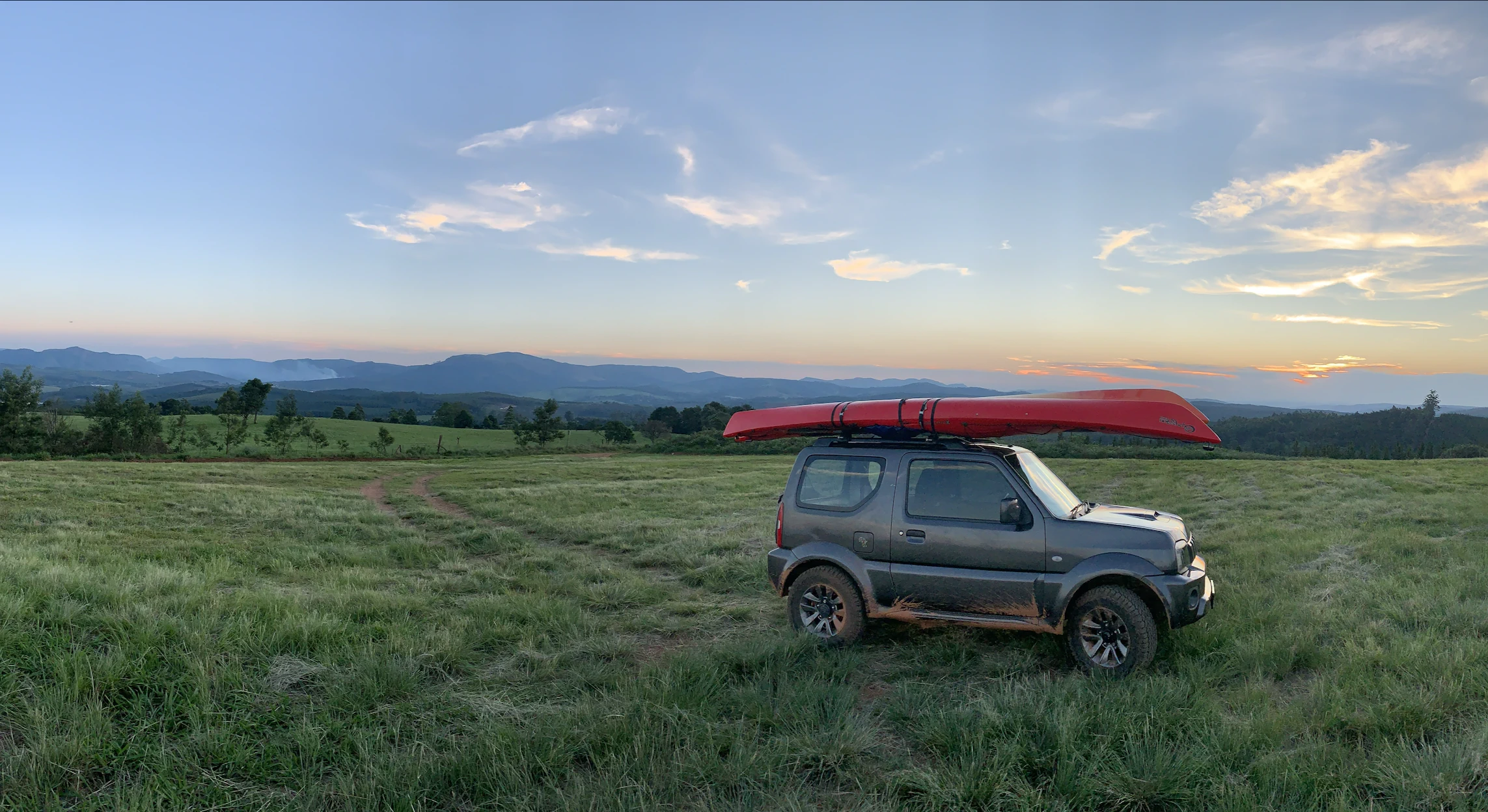
BUILD 001 / REAL-WORLD CONTEXT
ATLAS: ROOF SPACE AS A TOOL, NOT A PERMANENT LOAD.
Atlas is Jimny Lab’s first build: a daily-driven 2017 Gen 3 used for weekend travel, 4x4 trips and light touring. Its roof approach changes with the job. Thule 118 cm bars, a Thule Trail Basket, a Thule Motion L Roof Box and kayak use all show the same principle: different trips create different carrying requirements.
Atlas does not need to carry every roof accessory all the time.
Keeping roof equipment removable also means Atlas does not carry unnecessary roof mass on trips where it is not needed.
VIEW BUILD 001 →CURRENT OPTIONS
ROOF & LOAD CARRYING IN THE JIMNY LAB CATALOGUE.
KRSJ100TSuzuki Jimny 3-Door Slimline 3 Roof Rack Kit Approx. product mass: 37.26 kgROOF-LOAD REVIEW RECOMMENDED
KRSJ101TSuzuki Jimny 5-Door Slimline 3 Roof Rack Kit Approx. product mass: 43.36 kgROOF-LOAD REVIEW RECOMMENDED
KRSJ007Suzuki Jimny Load Bar Kit Gen 4.1 + Gen 4.2 low-profile alternative where a full platform is not required. Front Runner specifies 25 kg per load bar, evenly distributed; the vehicle manufacturer’s roof-load limit still governs the complete system.
LASJ004Suzuki Jimny Ladder Access accessory for roof-carried equipment.
TENT257Feather-Lite II Rooftop Tent Approx. product mass: 49 kgCOMPLETE ROOF-SYSTEM REVIEW REQUIRED
These are current catalogue examples, not a complete instruction to fit every roof product to every Jimny. Product pages carry the current compatibility context.
PROFESSIONAL FITMENT
BUILD THE ROOF SYSTEM AS A SYSTEM.
Jimny Lab reviews the product, carrier mass, Jimny generation, existing equipment and intended use together. Where a chosen setup falls outside published vehicle guidance, that trade-off should be made clear before final quotation or fitment.
PROFESSIONAL FITMENT DOES NOT CHANGE THE VEHICLE MANUFACTURER’S ROOF-LOAD LIMIT. Fitment is not promised for every product or every configuration, and Jimny Lab fitting a product should not be treated as certification of manufacturer compliance.
REFERENCE NOTES
SOURCE CHECKS USED FOR THIS GUIDE.
Suzuki Auto South AfricaJimny 5-Door brochure — 30 kg maximum roof load, including rack / carrier system.
Official Suzuki accessory brochureCurrent 3-door Jimny accessory guidance — 30 kg maximum roof load, including carrier modules.
Dometic / Front RunnerKRSJ100T official product source — net weight 37.26 kg.
Dometic / Front RunnerKRSJ101T official product source — net weight 43.36 kg.
Dometic / Front RunnerTENT257 official product source — 49 kg published product weight.
NEXT STEP